
Looking for Local SEO in Swannanoa, NC?
Local SEO for Swannanoa, NC small businesses. Modern Merchant — locally based in Asheville, payments + POS + CRM + automation under one roof.

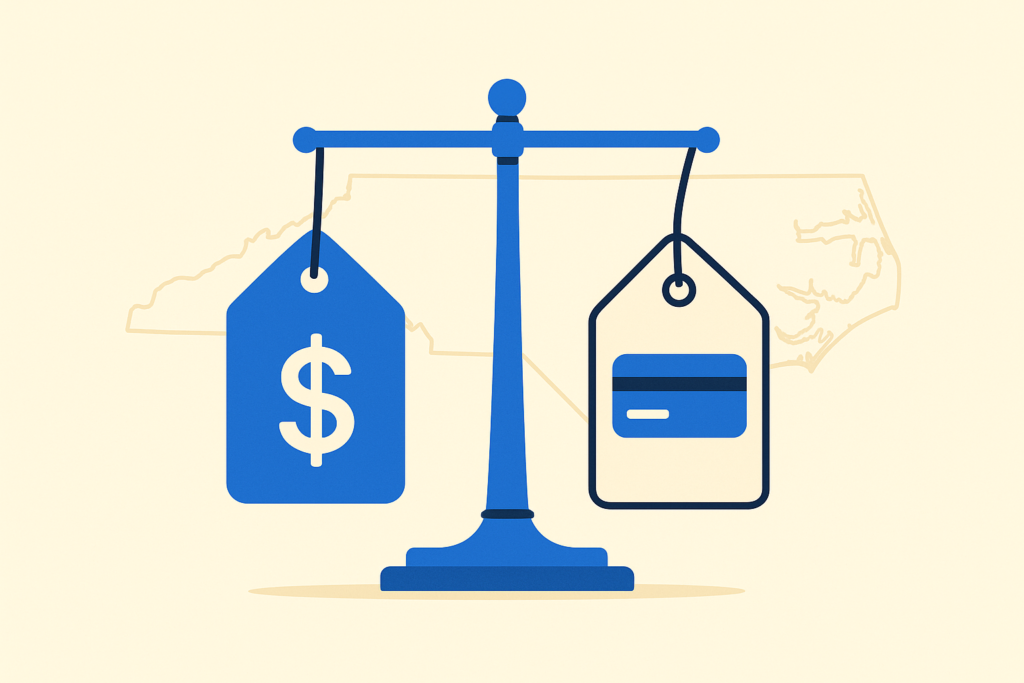
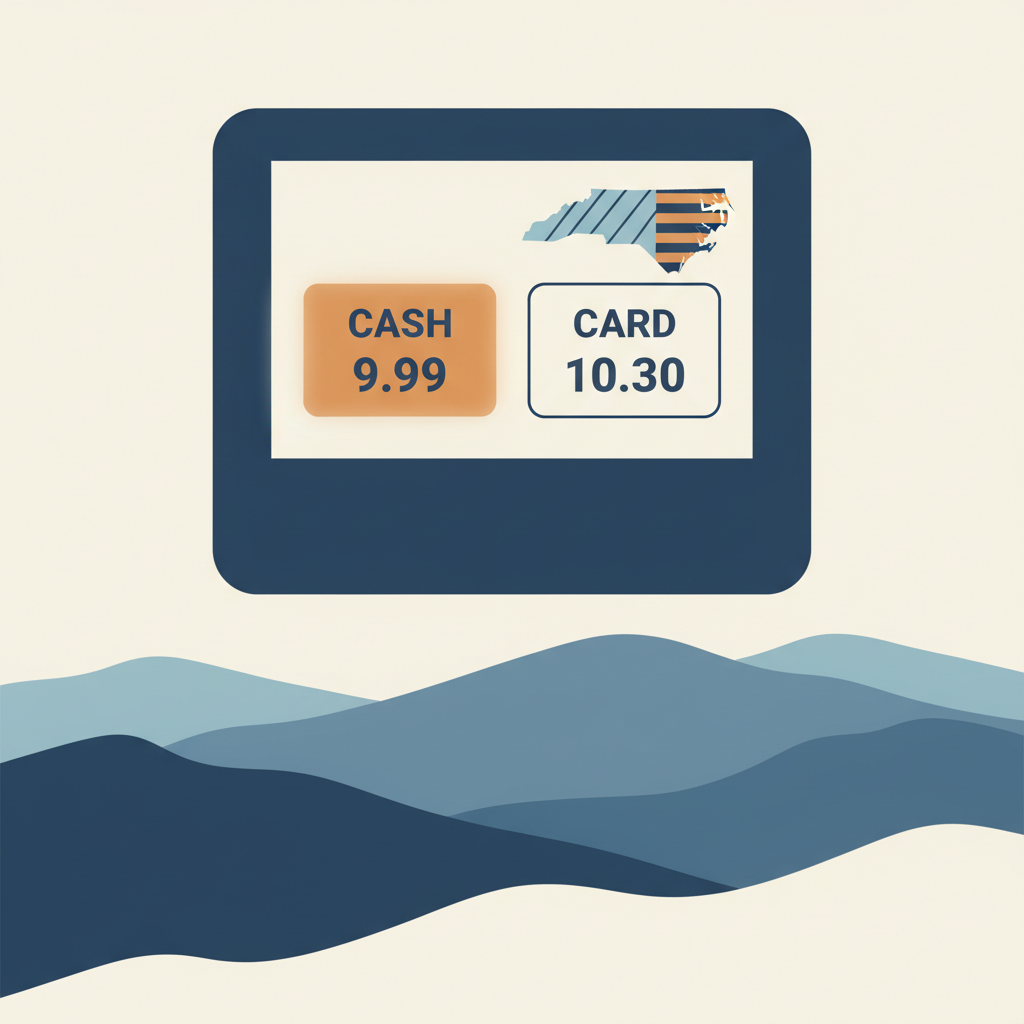
If you’re a small business in NC and you’re tired of eating 2.5%–3% on every card transaction, you’ve probably heard the pitch from at least one merchant services rep: “You can pass the credit card fees to your customers — it’s totally legal.”
Sometimes that’s true. Sometimes it’s a fast track to a Visa fine and a chargeback storm. The difference comes down to which program you’re actually running, and most of the people pitching them don’t make the distinction clearly.
Short answer: Cash discount programs are legal in all 50 states (NC included) and the simplest way to recover card-processing costs. Dual pricing is legal too but requires correct disclosure and equipment. Surcharging (just adding a fee to credit card transactions) is legal in NC but has strict card-network rules and is the easiest one to mess up. Pick the right one for your business and the math gets very interesting very quickly.
1. Cash discount program
You raise your shelf prices by ~3.5% (the cost of card processing) and then offer customers a “cash discount” of 3.5% if they pay with cash. From the customer’s perspective: cards are full price, cash is cheaper. From your perspective: you’ve eliminated card processing as a cost line.
This is the cleanest program. Visa and Mastercard explicitly allow it. NC has no specific restrictions. The disclosure required is minimal (a sign at the register noting the cash discount).
2. Dual pricing
You display two prices on every item: a cash price and a credit card price. The card price is higher by ~3.5%. Customer chooses at checkout. The transaction is processed at whichever price they selected.
Functionally identical math to cash discount. Different disclosure model (price displayed at item level, not just at register). Requires POS that supports dual-pricing display.
3. Surcharging
You charge the listed price PLUS an additional fee on credit card transactions only (debit cards can’t be surcharged under federal law). This is the riskiest of the three because:
Most small businesses that “tried surcharging” actually ran a non-compliant version, got flagged by their processor, and got either a fine or an account termination. The math is the same as cash discount; the compliance overhead is much higher. We almost never recommend surcharging to NC clients when cash discount is on the table.
North Carolina has no state-level statute prohibiting cash discount, dual pricing, or surcharging. NC follows federal guidance on debit-card surcharge prohibitions (Durbin Amendment).
What you DO need:
For cash discount: A clear sign at the point of sale stating the discount. POS must apply it at checkout. That’s it.
For dual pricing: Both prices clearly displayed at the item level (shelf tag, menu, online listing). POS must support dual-price display and processing.
For surcharging: Visa/Mastercard registration (30 days), point-of-entry signage, point-of-sale signage, receipt itemization of the surcharge, debit-card detection in your POS, surcharge capped at 3%.
If your processor is selling you “surcharging” as a turnkey program with no compliance setup involved, walk away. They’re either not running it correctly or they’re going to bill you for compliance later.
Same anonymized restaurant we used in the interchange-plus vs. flat-rate post: $42,000/month in card sales, paying $812.30/month in processing fees on interchange-plus pricing.
Without any cash discount/dual-pricing program: Restaurant absorbs the $812.30/month as a cost of doing business. Annual: $9,748.
With cash discount program: Restaurant raises menu prices 3.5%, offers cash discount of 3.5%. Customers paying cash effectively pay the original price; customers paying card pay 3.5% more, which approximately covers the processing fee. Restaurant’s monthly processing cost drops to roughly the residual interchange that the cash discount can’t cover (typically <$100/month for this volume). Annual savings: ~$8,500.
With dual pricing: Same math. Different presentation (prices shown both ways on menu). Slightly more friction at point of sale because servers/cashiers field “is it really X price?” questions. We typically recommend dual pricing for retail, cash discount for restaurants and service businesses.
Strong fit:
Weaker fit:
If you’re paying more than 2.5% effective rate: This is the highest-leverage change you can make to your processing cost structure. Cash discount is straightforward to set up (most modern POS systems support it natively, including Acadia POS). The compliance burden is minimal.
If you’re already on interchange-plus pricing and your effective rate is below 2.0%: Cash discount might be over-engineering. The math still works in your favor, but the friction with customers may not be worth the additional savings.
If you’re considering surcharging: Almost always, the right answer is “do cash discount instead.” Same math, much less compliance risk, faster to deploy.
Yes. North Carolina has no state law prohibiting cash discount programs. Visa and Mastercard explicitly allow them. Required disclosure is a sign at the point of sale stating the discount.
Cash discount raises base prices and offers a discount for cash payment. Surcharging keeps base prices the same and adds a fee to credit card transactions. The math is similar; the compliance overhead is very different. Surcharging requires Visa/MC registration, debit-card detection, and capped surcharge percentage. Cash discount has none of those requirements.
Cash discount applies to all card transactions equally — both credit and debit. (Surcharging, by contrast, cannot legally be applied to debit cards under the federal Durbin Amendment.)
Yes. Acadia POS, which Modern Merchant deploys to most of our retail and restaurant clients, includes native cash discount and dual pricing support. Setup typically takes 15 minutes during initial deployment.
The standard answer: “We offer a cash discount because credit card processing costs us about 3.5% per transaction. If you pay with cash, we can pass that savings on to you.” Most customers understand immediately. The few who don’t usually pay with card anyway.
In our experience deploying cash discount across dozens of WNC small businesses since 2022, no — assuming the signage is clear and the staff handle the conversation well. The customers most likely to leave a negative review are the ones surprised at checkout. Clear signage at point of entry eliminates that surprise.
Modern Merchant deploys cash discount and dual pricing programs as part of our standard payment processing setup for Asheville-area retail, restaurants, and service businesses. We handle POS configuration, signage spec, and staff training. Free statement analysis →
Local SEO for Swannanoa, NC small businesses. Modern Merchant — locally based in Asheville, payments + POS + CRM + automation under one roof.
Web design for Swannanoa, NC small businesses. Modern Merchant — locally based in Asheville, payments + POS + CRM + automation under one roof.
POS systems for Swannanoa, NC small businesses. Modern Merchant — locally based in Asheville, payments + POS + CRM + automation under one roof.
Credit card processing for Swannanoa, NC small businesses. Modern Merchant — locally based in Asheville, payments + POS + CRM + automation under one roof.
Local SEO for Marion, NC small businesses. Modern Merchant — locally based in Asheville, payments + POS + CRM + automation under one roof.
Web design for Marion, NC small businesses. Modern Merchant — locally based in Asheville, payments + POS + CRM + automation under one roof.